A Turning Point for BC Housing: Why the Ground is Shifting Under Our Feet

By Jim Vasto

After 20 years practicing architecture in this province, and 27 years in the field overall, I have learned to read a market by what is happening on the ground, not just in the headlines.

Right now, the ground is telling an interesting story. British Columbia's housing market is genuinely struggling, but underneath that struggle, some of the structural barriers that have made good housing difficult to build are finally moving.

Let's start with the honest picture.

British Columbia's population declined in 2025 for only the second time in its recorded history, falling by more than 41,000 people as international migration slowed sharply following federal changes to immigration policy. The housing market is under real pressure as well. Presale launches across the Lower Mainland have fallen dramatically, and CMHC is forecasting historically weak housing construction in British Columbia over the next several years.

I heard the human side of this recently from a real estate agent I have worked with for years. He told me he is seeing some of the best land deals he has come across in over 15 years.

That is not necessarily a coincidence. When demand softens, land priced for a growth story that is not happening right now can become available to builders and developers who are prepared to put shovels in the ground. For architects like me, that can create an opening too. Projects that were priced out of reach during the boom may become worth exploring again.

And this is where the optimism comes in.

Vancouver has been changing its approach to housing, and the latest building code changes could take that process further. Council first approved single egress and scissor stair configurations in late 2025, with the changes taking effect in the Vancouver Building By-law in January 2026. Last month, Council went further, passing a zoning amendment that specifically enables single exit staircase buildings in R3 districts, along with a floor space ratio increase there. Notably, this amendment passed the same meeting where Council rejected the broader Villages Plan, so it is easy to miss, but it is arguably the more consequential outcome for small lot owners.

This matters because conventional two stair designs can consume significant floor area on small sites. A carefully designed single stair building can use that space more efficiently, potentially making smaller multifamily buildings more viable on individual lots, particularly in R3 zones where a large share of Vancouver's standard lots sit.

This does not mean Vancouver's standard 33 foot lots were previously unbuildable for multifamily housing. Since 2023, Vancouver has permitted multiplexes in lower density areas. The more important change is that new egress options can expand the range of building forms that can work efficiently on relatively small sites.

Cost relief is appearing elsewhere too.

Vancouver initially approved a temporary 20 percent reduction in Development Cost Levies. In July 2026, Council approved an updated financing framework that maintains reduced DCL rates.

Metro Vancouver has also rolled its 2026 development cost charges back to 2025 levels while reducing planned increases for 2027. The regional government estimated the changes would mean roughly $389 million in foregone revenue over six years.

Other municipalities are taking similar steps. Surrey has rolled back residential development cost charges, while Kelowna has introduced a temporary reduction.

None of this guarantees a housing recovery. High financing costs, construction expenses and weak demand remain serious obstacles. But these changes could create an unusual opportunity.

If land prices remain softer, development costs fall, building rules become more flexible and population growth eventually returns, the conditions for smaller housing projects could improve considerably.

I have practiced through several cycles, and the best buildings were not always produced during the boom years. They were often created during quieter periods, when land was more reasonably priced and the rules finally caught up with common sense design.

I think we may be entering one of those windows now.

The ground is shifting. The question is what we choose to build on it.

Trent Letwiniuk Memorial Endowment

The late Trent Letwiniuk, Principal and cofounder of Gravity, was a graduate of the Architectural Technologies Program at Southern Alberta Institute of Technology (SAIT).

In his honour, Gravity has created an endowment with SAIT so that at least one student each year will be granted an award.

The students will be in the Architectural Technologies Program in the School of Construction, enrolled in their second year, have financial need, and be interested in a career in residential design.

Our team at Gravity continues to include many SAIT graduates, and we are proud to be able to permanently support this program that has in many ways made the success of our firm possible.


While Gravity initiated and supported the initial endowment, anyone who wishes to contribute may do so here. Once you have indicated the amount you would like to give, click the "I wish to support another area..." A pop up window will appear, and you can type in the fund name or scroll down to awards and find the award name. The fund is the Trent Letwiniuk Memorial. All donations will receive a tax receipt.

Inertia's Killarney Rowhouse is DP Approved!

Introducing Killarney 8 + 8 by Inertia Residential Design, our sister company!

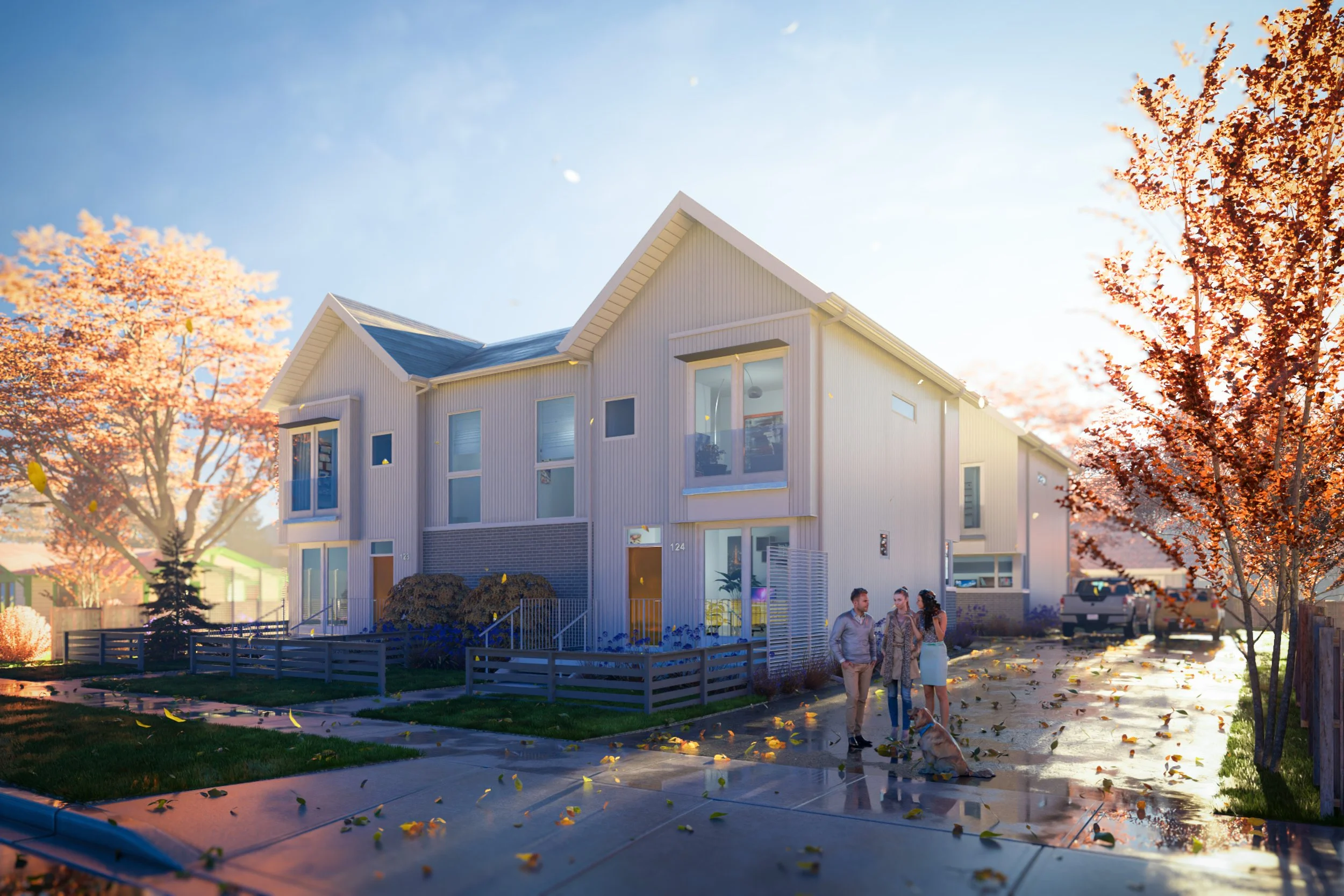
The development permit has been approved for these two four-unit rowhouse buildings, each incorporating secondary suites, for a total of 16 units on a modest site in Killarney, Calgary.

This rowhouse project draws inspirations from industrial and warehouse typologies, expressed through a strong peaked roofline, large loft-like windows, and metal cladding. The result is a modern-industrial infill project that explores a unique approach to missing-middle housing.

Click below to learn more.